We could all use a little history lesson sometimes, especially when new buzzwords start to dominate the zeitgeist.
That’s where I feel like we are with “payments as a service (PaaS)” and “embedded payments.” They trend like hot new kids in the industry media, but in reality these are new-fangled words for the same services financial institutions have been providing for decades. If we can all share this understanding, I believe it will lead to better outcomes when describing these programs to institution leadership, the compliance folks, and regulators.
Now let’s take a little journey back in time to learn how we got here …
Early Payment Processing: Manual Uploads to Automated Embedded Payments
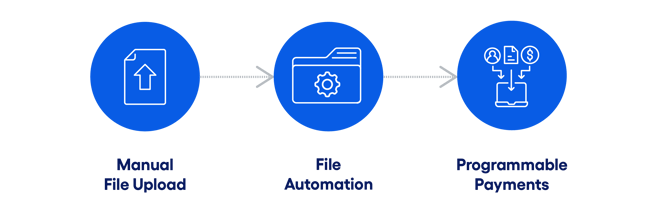
Prior to the new millennium, transactional banking was limited to large corporate clients and large payroll providers that set up manual file upload processes, typically with out-of-band confirmation of control totals for their largest customers.
In the 1980s and early 90s, the payment processing landscape was dominated by manual file uploads for Automated Clearing House (ACH) transactions. Financial institutions would manually prepare and upload files to process payments, a labor-intensive method that was prone to error. This period saw the initial steps towards digitizing payments emerge, driven by the need to more efficiently handle increasing transaction volumes. Processes were highly customized, hard to scale, and required technical and operational resources on both sides of the integration to operate.
Late 1990s to 2000s: File Automation and Embedded Payment Evolution
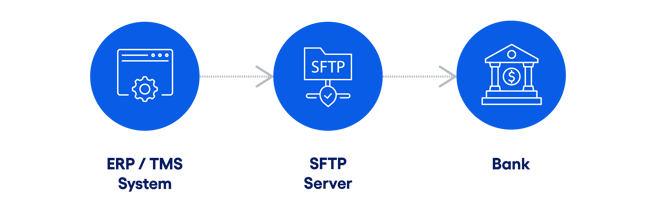
The 2000s brought significant advancements in technology, leading to the automation of file sharing. This era saw the introduction of more sophisticated software that could automatically generate and share payment files, reducing the need for manual intervention. These systems improved accuracy and efficiency, allowing financial institutions to handle larger volumes of transactions with greater ease.
Transactional banking support for batches of transactions was next expanded to payment facilitators and technology solution providers. With the advent of schedulers, institutions were able to automate, secure, and centralize file transfers. These solutions provided a safe and auditable method to automatically transfer information both inside and outside the enterprise. They also streamlined file transfers and related business processes without the need for extensive programming or special skills.
2017: Programmable Payments and API‑Driven Embedded Solutions
By 2017, the payments industry had evolved further with the introduction of programmable payments. These platforms leverage cloud technology and Application Programming Interfaces (APIs) to offer scalable, flexible, and integrated payment solutions. Programmable payments allowed businesses to manage various payment types through a single API and significantly simplifying the payment process. The use of APIs enables seamless integration with existing systems, providing real-time processing and enhanced security features.
The Role of Sponsor Banks
Throughout these technological advancements, the role of sponsor banks remained constant. Sponsor banks provide the necessary financial infrastructure and regulatory compliance, enabling fintech companies and other businesses to offer payment services. This partnership model allows non-banks to successfully pursue their business goals while seamlessly incorporating payments.
Why Embedded Payments Matter for Community Financial Institutions
For community financial institutions, understanding this evolution is crucial as they consider offering sponsor bank services. Discussing the long history and technological advancements in embedded payments can help leadership appreciate the continuity and reliability of these services as they consider and appropriately price risk into programs. It also highlights the potential for growth and innovation within a familiar regulatory framework.
Likewise, when introducing new product offerings, it is essential for community institutions to educate regulators about the similarities between embedded payments and traditional products they have successfully managed. Emphasizing the continuity in compliance programs – such as Know Your Customer (KYC), Anti-Money Laundering (AML), Bank Secrecy Act (BSA), and Office of Foreign Assets Control (OFAC) oversight – can help regulators understand how existing frameworks can be adapted.
By framing the conversation around the evolution of embedded payments and the consistent role of sponsor banks, community financial institutions can effectively communicate the safety, reliability, and potential of these services. This approach not only fosters innovation but also ensures regulatory confidence and compliance.
Who knew a history lesson would turn out to be so fascinating?
Ready for the next chapter in embedded payments? Learn more at jhorhestrator.com.



.svg)